Scorability
Designing a recruiting knowledge system for six sports
Families had to piece together recruiting advice from fragmented, inconsistent sources, and the rules changed by sport, position, and year in high school. I designed a connected knowledge system with a shared guide architecture and sport-specific paths, now live across five sports with a sixth in development.
- Company
- Scorability
- When
- 2026
- My role
- Lead content designer
- I owned
- Research synthesis, information architecture, journey design, guide framework, wireframes, routing logic, UX and editorial copy, and delivery
- Collaborators
- Subject-matter experts for accuracy; visual design for UI execution; web development for implementation
- Status
- Live across five sports; sixth sport in development
A1
The problem
The assignment looked like dozens of pages. The real problem was creating one trustworthy system that could answer recurring questions without flattening the differences between sports.
Families searching for answers found scattered, contradictory advice. I saw that as a huge opportunity to build trust at the top of the funnel: answer their questions better than anyone else, and Scorability becomes the expert they come back to.
A2
The pattern
Every sport asks the same twelve core questions. Some sports have questions nobody else does.
- How it works
- Levels of play
- Timeline
- What coaches evaluate
- Film, camps & exposure
- Building relationships
- Offers
- Scholarships
- Choosing the right school
- Transfer portal
- Mental side
- Most common myths
- VolleyballClub volleyball
- BasketballAAU & grassroots · NIL
- SoccerThe club soccer landscape
- BaseballTravel ball & showcases · Choosing a showcase
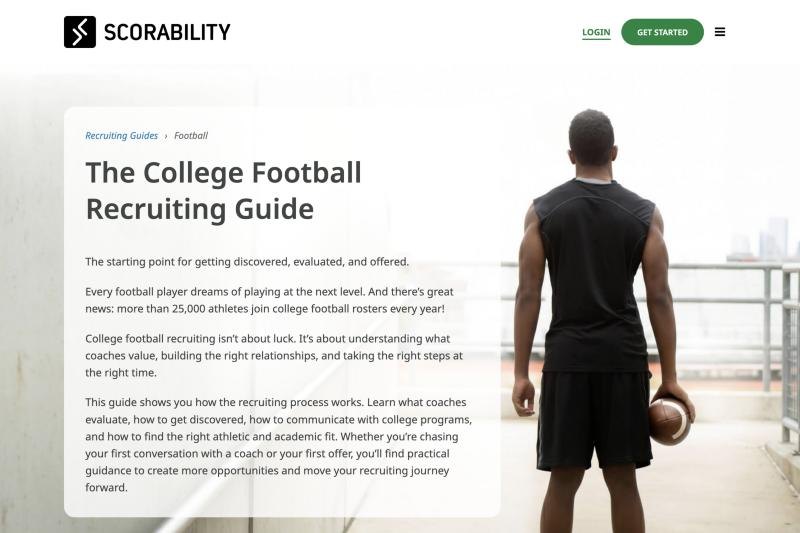
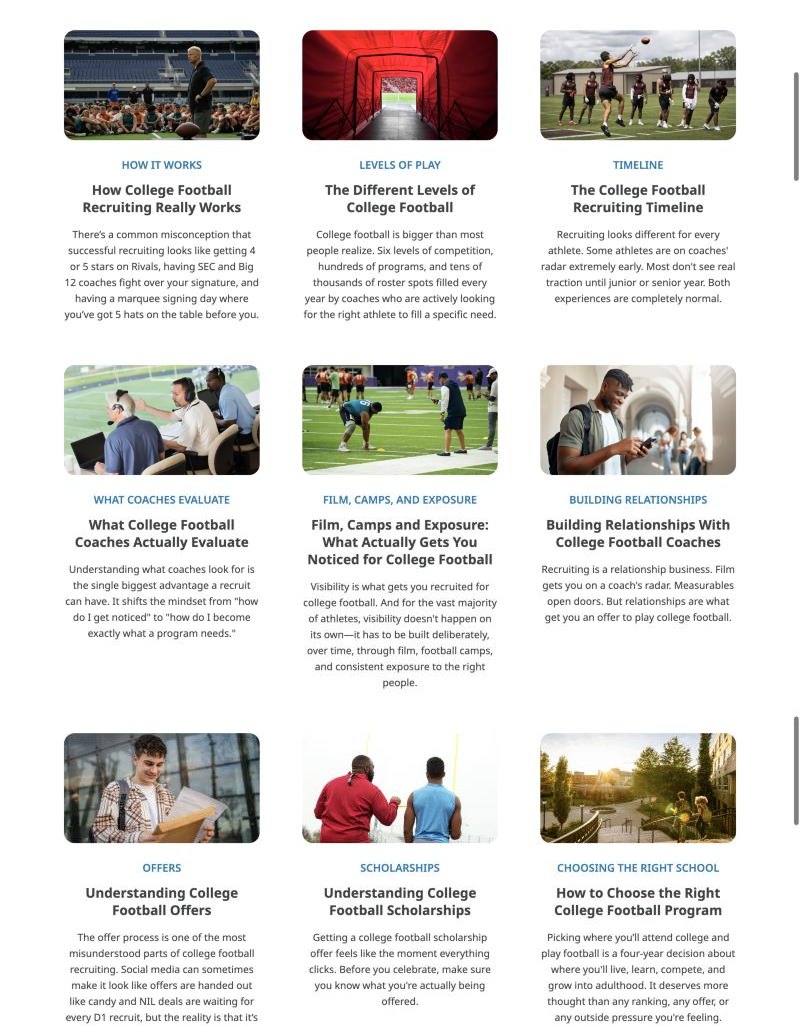
That split became the design: a shared spine of guides that every sport gets, plus room for the parts of recruiting that only exist in one sport, like club volleyball or NIL in basketball.
The twelve-guide spine came out of my own keyword research and user journey mapping: the same questions surfaced for every sport, at the same stages of the recruiting process.
A3
The model
One hub per sport. The same spine under each. Sport-specific guides where the sport works differently.
Football
12 shared guides. Nothing extra needed: the spine covers it.
Volleyball
12 shared guides + Club volleyball
Basketball
12 shared guides + AAU & grassroots · NIL
Soccer
12 shared guides + Club soccer landscape
Baseball
12 shared guides + Travel ball & showcases · Choosing a showcase
Softball
In development. It starts from the same twelve-guide spine.
Fig. A3Pick a sport to light up its branch. Every sport shares the same twelve guides; the larger dots are the ones only that sport needs. Hover a dot for its title. Drawn from the live site.
B1
Methodology
Build the structure once. Teach before selling. Let each sport bend the model without breaking it.
-
Research the demand, then get it right
Keyword research and competitor analysis showed what families were actually searching for. Subject-matter experts made sure every answer was accurate.
-
One spine, sport-specific spokes
Every sport gets the same twelve core guides, so a new sport starts from a proven structure instead of a blank page.
The spine keeps the system consistent for families who follow more than one sport and for the team maintaining it. Sport-specific guides are added only where the sport genuinely works differently.
-
Teach first, sell later
Good top-of-funnel content builds trust, answers the question, then leads to conversion, in that order. Conversion points go where readers are actually ready for them.
On the sport hubs, I kept the opening educational and introduced the product only after the reader understood the recruiting landscape and what they needed to do next. Inside each guide, conversion prompts came after the answer, not before it. At the end, readers received a stronger next step alongside related guides, so conversion never became a dead end.
-
Route by the reader's question
Guides link to the next question a reader is likely to have, so no one has to go back to the index to keep going.
The rule was: answer the reader’s current question, then route them to the next question their stage, sport, or situation would naturally create. The central hub remained available as an escape hatch, but readers shouldn’t have to return to an index to continue learning.
The tradeoff. I rejected both extremes: building six completely separate content programs and creating one generic guide set with the sport names swapped. The twelve-guide spine reduced duplication and made the system maintainable; sport-specific branches preserved the differences that actually mattered.
B2
Outcome
One reusable architecture now supports five live sports, 60 core guide paths, and sport-specific extensions. Softball began from the same framework instead of a blank page.
Live hubs: Football ↗ Volleyball ↗ Basketball ↗ Soccer ↗ Baseball ↗
The architecture and content shipped as designed. The final presentation layer evolved after handoff.
B3
Reflection
The architecture was designed to scale. The feedback and maintenance model should have been designed alongside it.
If I did it again, I'd build measurement and governance into the system earlier. I focused first on making the information accurate, navigable, and repeatable across sports. I would also define how we'd validate each path with athletes and families, what behavior would tell us the guides were working, and how the content would stay current as recruiting rules changed.
What I'm proudest of is that I didn't treat the assignment as a pile of standalone pages. I built one connected system with a shared core and enough flexibility for each sport to work differently. That meant every new sport could build on what already existed instead of starting over. I owned the work from research and information architecture through wireframes, copy, and delivery, and turned an ambiguous brief into something the team could keep extending.